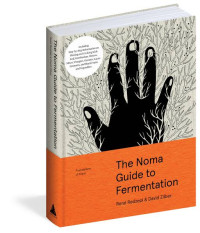
E-Book
The Noma Guide to Fermentation
There are thousands of products of fermentation, from beer and wine to cheese to kimchi to soy sauce. They’re all dramati-
cally different creations, of course, but they’re unified by the same basic process. Microbes—bacteria, molds, yeasts, or a
combination thereof—break down or convert the molecules in food, producing new flavors as a result. Take lacto-fermented
pickles, for instance, where bacteria consume sugar and generate lactic acid, souring the vegetables and the brine in
which they sit, simultaneously preserving them and rendering them more delicious. Cascades of secondary reactions
contribute layers of flavors and aromas that didn’t exist in the original, unfermented product. The best ferments still retain
much of their original character, whether that’s a touch of residual sweetness in a carrot vinegar or the floral perfume of
wild roses in a rose kombucha, while simultaneously being transformed into something entirely new.
Availability
Detail Information
- Series Title
-
Foundations of Flavor
- Call Number
-
641.4 Red-n
- Publisher
- : artisan., 2018
- Collation
-
464 p.
- Language
-
English
- ISBN/ISSN
-
978-1-57965-718-5
- Classification
-
641
- Subject(s)
-
-
 Computer Science, Information & General Works
 Philosophy & Psychology
 Religion
 Social Sciences
 Language
 Pure Science
 Applied Sciences
 Art & Recreation
 All about Bali
 Literature
 History & Geography
 Academic Scientific